How Familiar Shapes Can Mislead Your First Impression
Use pattern recognition to read ambiguous images more carefully: check the marks, context, and viewing angle before deciding what a shape shows.
You glance at a tangle of branches against a gray sky and spot a face: two dark knots for eyes, a split twig for a mouth. Pattern recognition makes the ambiguous scene feel legible in a flash. That first impression can be useful, but it can also draw attention away from details that do not fit.
The issue is not that familiar-shape recognition is always wrong. It is that a convincing resemblance can feel like a complete explanation before you have checked the image around it. A few simple checks help you keep the first reading in view while deciding whether the visible details support it.
Check what the familiar shape leaves unexplained
Once a stain suggests a face, a curved mark may seem like a smile and a shadow like an eye socket. Ask what your interpretation accounts for, then look for marks it has to ignore or reinterpret.
Try describing the image without naming an object: “There are two dark spots above a short horizontal mark.” This keeps your attention on visible features and gives other arrangements room to appear.
Say you notice a stain on a kitchen tile that looks like a bird. You first identify its dark patch, narrow scratch, and curved edge; then you notice that the apparent wing continues into a grout line and the supposed beak is a separate mark. The result is a less complete bird reading, even though the resemblance may still be visible.
Write down or say what you can see before deciding what it represents.
Compare the whole pattern with its parts
Two marks may suggest eyes because they sit together, while a line below them resembles a mouth. Look at those marks separately, then return to the whole arrangement. Check whether the relationship between parts supports the object you recognized or whether only one or two details do.
In a drawing, follow the outline with your gaze. In a photograph, compare the apparent features with nearby textures, shadows, and edges. A mark that looked like part of an object may turn out to cross it or continue into the background.
Neither the overall shape nor an isolated detail settles the question by itself. Move between both views and note whether the interpretation still fits.
Use context to test the first reading
A dark oval among leaves might resemble an animal’s eye; on a painted wall, a similar oval might look like a chipped patch. Look at what touches the ambiguous shape, what sits behind it, and whether the nearby texture belongs to the object you think you see.
Lighting and overlap matter, too. A shadow can create an apparent contour, while a line that continues into another object can weaken your first reading. Context does not decide the answer automatically, but it supplies clues that a close-up view may hide.
A cloud can briefly look like a face when you focus on a few marks. Shift your gaze to the larger cloud bank and the surrounding shapes may make the face less convincing.
Include the nearby scene in your description, not just the shape that caught your eye.
Change scale or viewpoint before settling
Look away and return, step back from a printed image, or view a digital picture as a thumbnail and then enlarged. At a smaller scale, broad shapes stand out; closer up, texture and separate edges become easier to notice. If your interpretation holds only at one scale, treat it as a reading tied to that view.
For a real object, shift your position only if it is safe and practical. A different angle may reveal that a shadow formed the apparent outline. If moving is not appropriate, compare the visible edges and the direction of the light from where you are.
Notice which parts change when you change your view.
Keep recognition separate from a conclusion
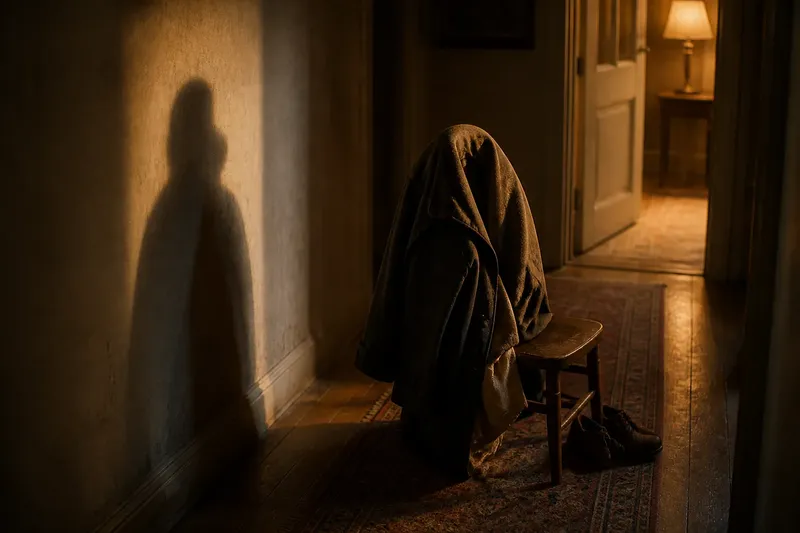
Seeing a familiar form is evidence of how the marks strike you, not proof that the object is physically present. A pile of clothes in a dim room may resemble a seated person. Turning on a light can clarify the scene, but it does not make the first impression unusual or foolish.
Use language that leaves room for uncertainty: “It looks like a face from here,” or “I first read that mark as a handle.” For art or image description, you can say a composition evokes a mask without claiming it depicts one.
Say you are describing an abstract poster with two dark circles and a curved line. You note those shapes, compare them with the rest of the composition, and find that the circles do not form a consistent face outline. Your description can then say that the image evokes a face while leaving open whether the artist intended one.
Use this checklist to decide what to inspect next
- Observation: You can name only the object, not its visible marks. If so, describe the marks without labels; if you already have a plain description, move on to checking their arrangement.
- Observation: The interpretation depends on one or two suggestive features. If so, compare the other parts with the proposed object; if several parts fit together, check the surrounding context next.
- Observation: An apparent edge continues into a nearby line, shadow, or object. If so, reconsider where the object’s boundary lies; if the edge remains distinct, compare the texture around it.
- Observation: Nearby shapes or surfaces do not fit your first reading. If so, widen your view and consider another arrangement; if the context supports the reading, check it from a different scale.
- Observation: The shape changes substantially between thumbnail and enlarged views. If so, describe which scale supports the impression and keep the reading provisional; if it remains similar, check whether a new angle changes the outline.
- Observation: A shift in viewpoint reveals that a shadow or overlap formed part of the apparent shape. If so, revise your account to include that visual cause; if the outline remains visible, state what is clear and what remains uncertain.
Imagine a viewer looking at a photo of a coat draped over a chair in a dim hallway. They first see a person standing there, then describe the visible clues: a dark upper shape, a long vertical fold, and a pale patch near the floor. They notice the fold continues into the coat’s sleeve, widen the view to include the chair, and turn on the hallway light. The outline now reads more clearly as clothing on furniture, so their description changes from “someone is standing there” to “the coat briefly looked like a person in the dim light.” The first impression remains part of the experience, but the surrounding evidence supports a different account.
What questions help you check an ambiguous image?
Why do ambiguous images resemble familiar objects?
Partial marks can form arrangements that resemble familiar shapes. A few features in a suggestive relationship may be enough to prompt a quick reading.
Does seeing a face mean an image contains one?
No. Ordinary shapes can happen to resemble facial features. Check the outline and surrounding context before describing the image as a depiction of a face.
How can I tell if a pattern is leading me astray?
Describe the visible marks without naming them, then check whether the proposed object accounts for their connections and nearby details. If the reading depends on overlooking several features, keep it provisional.
Can another person’s interpretation help?
Yes. Someone else may notice a mark that your first reading absorbed into the familiar shape. Compare the details each of you sees rather than treating agreement as the only test.
Let a first impression remain provisional
Pattern recognition gives an ambiguous image a quick reading; checking the parts, context, and viewing conditions helps you decide how much confidence to place in it. You may keep the first interpretation, revise it, or leave the image unresolved.
When you describe what you see, distinguish the visible marks from the object they suggest. That small wording choice makes room for both a vivid first impression and a more careful account.