A Window View Worth a Second Look
A rainy-window looking exercise helps you notice how reflections, movement, and overlapping layers shape attention, with a simple way to observe a familiar view.
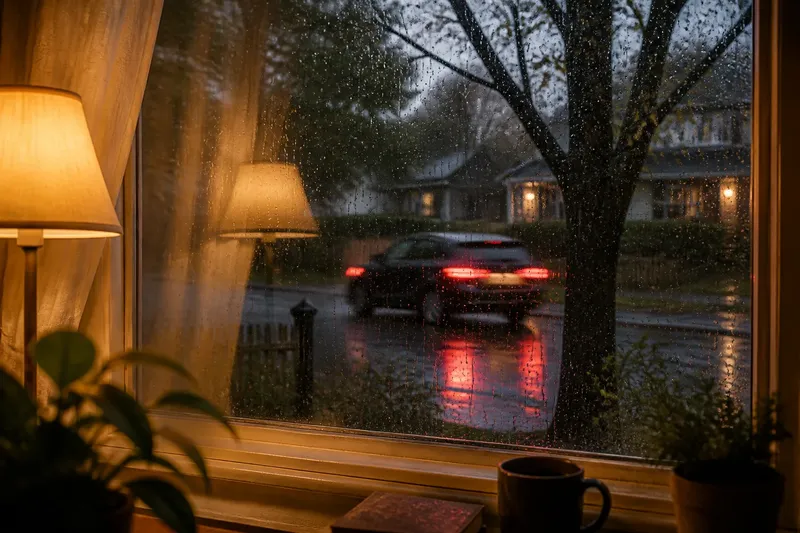
A bus passes the kitchen window, and its red tail lights slide across a reflection of the ceiling lamp. For a moment, the room and the street seem to share the same pane. A rainy-window looking exercise can help you notice how attention moves between those layers, not just how raindrops blur what lies beyond.
The useful question is not which layer is clearer. It is how you decide what belongs together: a reflection may seem part of the street, while a moving vehicle can pull your gaze away from the room. Taking a few deliberate looks gives you a way to notice those shifts without trying to interpret them as a message.
A rainy-window looking exercise tracks changing visual layers
A window can show the room in front of you and the outdoor scene behind it at once. The glass is not simply a transparent boundary. Depending on light and where you sit, it may also reflect a lamp, curtain, or your own shoulder.
Start by naming three layers in view: the nearby room, the glass surface, and the scene outdoors. They may not all be equally visible. A bright interior lamp can appear clearly in the glass; in daylight, the outdoor view may dominate and the reflection may nearly disappear.
Now let your attention move between layers. Notice that the room does not physically vanish when you focus outside, and the street does not stop existing when a reflection comes forward. What changes is the arrangement that feels most present.
Reflections can make separate scenes seem connected
A reflection may overlap an outdoor object in a way that suggests a relationship. A hanging plant reflected in the glass might appear to grow from a tree across the street. A lamp’s reflected shade may sit over a passing car. The overlap is visible, but it does not mean the objects share a location.
To observe the relationship, pick a reflected shape and a distant shape. Look at their outlines separately, then notice where they cross or align. If you shift your seat slightly, their apparent relationship may change even though neither object has moved in the way the image suggests.
That small change helps distinguish the view from the things in the view. The glass combines light arriving from different places, and your viewing position affects how those images meet.
Movement directs attention across a window
A moving car, bird, or branch can attract attention because its position changes while the rest of the scene stays relatively steady. Reflections can move too: a person walking behind you may pass across the glass while a distant building remains still.
Try watching one moving shape without following it all the way across the pane. Then shift your gaze to a fixed landmark, such as a mailbox or roof corner. Notice whether the moving object still feels prominent in the edge of your vision, or whether the fixed scene takes over.
Movement is only one cue. A familiar object, an unusual overlap, or a sudden change in light can also become the part you notice first. Naming what drew your attention is more useful than deciding that one view is the “right” one.
How can you compare layers without forcing your eyes?
Choose a comfortable seat with a view that includes both an interior reflection and an outdoor object. A window facing a street or garden can work; avoid leaning against an open window. Give each layer a turn, blinking normally and looking away if your eyes feel tired.
Use simple descriptions instead of trying to explain every detail:
- Room: “The pale curtain reflects along the left side.”
- Glass: “A thin water trail crosses the reflection.”
- Outside: “A dark fence stands behind the moving leaves.”
- Overlap: “The reflected curtain seems to touch the fence.”
These descriptions keep the observation grounded. They also help separate what you can see from what you might assume about the scene.
What changes when you shift your position?
Move your head a little to one side while keeping a distant landmark in view. A reflection may slide across the pane or become less noticeable, while the landmark remains in roughly the same place. This is a practical way to see that reflections depend on where you stand.
Imagine you are seated beside a living-room window. A hypothetical starting view includes a reflected floor lamp overlapping a tree trunk outside. First, you note the apparent overlap. Next, you shift your chair slightly to the left while keeping the tree trunk as your reference. The lamp reflection now appears beside the trunk rather than across it; the result is a changed visual relationship, not a changed tree or lamp. The tradeoff is that another reflection or outdoor detail may become more noticeable from the new position.
Use only a comfortable, safe position. There is no need to approach the glass or adjust anything that could make a window unstable.
Questions about looking through a rainy window?
Why do reflections show up more clearly at some times?
Interior reflections are easier to notice when the room is brighter relative to the outdoor view, while a brighter outdoor scene can make them less apparent. The balance can change with daylight, room lighting, and your position.
Does a reflected shape belong to the outdoor scene?
It may overlap an outdoor object, but the reflection comes from light in the room or another surface behind you. Shift your position and see whether the apparent alignment changes before deciding how the shapes relate.
Can I do the exercise with a photograph?
Yes. You can compare reflected and outdoor layers captured in the image, though the photograph preserves only one viewpoint and moment. It will not show reflections shifting as you move.
What if the glass is too wet or foggy to see details?
Notice broader shapes, movement, or the boundary between a lighter and darker area. If the view offers little to distinguish, stop and try another time rather than straining to make details appear.
A second look can separate appearance from assumption
A window view can make a reflection, a passing object, and a distant landmark seem like parts of one scene. Looking at each layer in turn helps you notice how that impression forms, especially when a small change in position alters an overlap.
The search phrase “rainy-window looking exercise” describes a simple way to practice this attention: name what is near, what is reflected, and what lies outside. One final useful check is to ask whether an apparent connection survives a change in viewpoint; if it does not, you have learned something about the image’s arrangement without needing to claim anything about the objects themselves.